

- This event has passed.
2022 Virtual Youth Mentoring Research Symposium
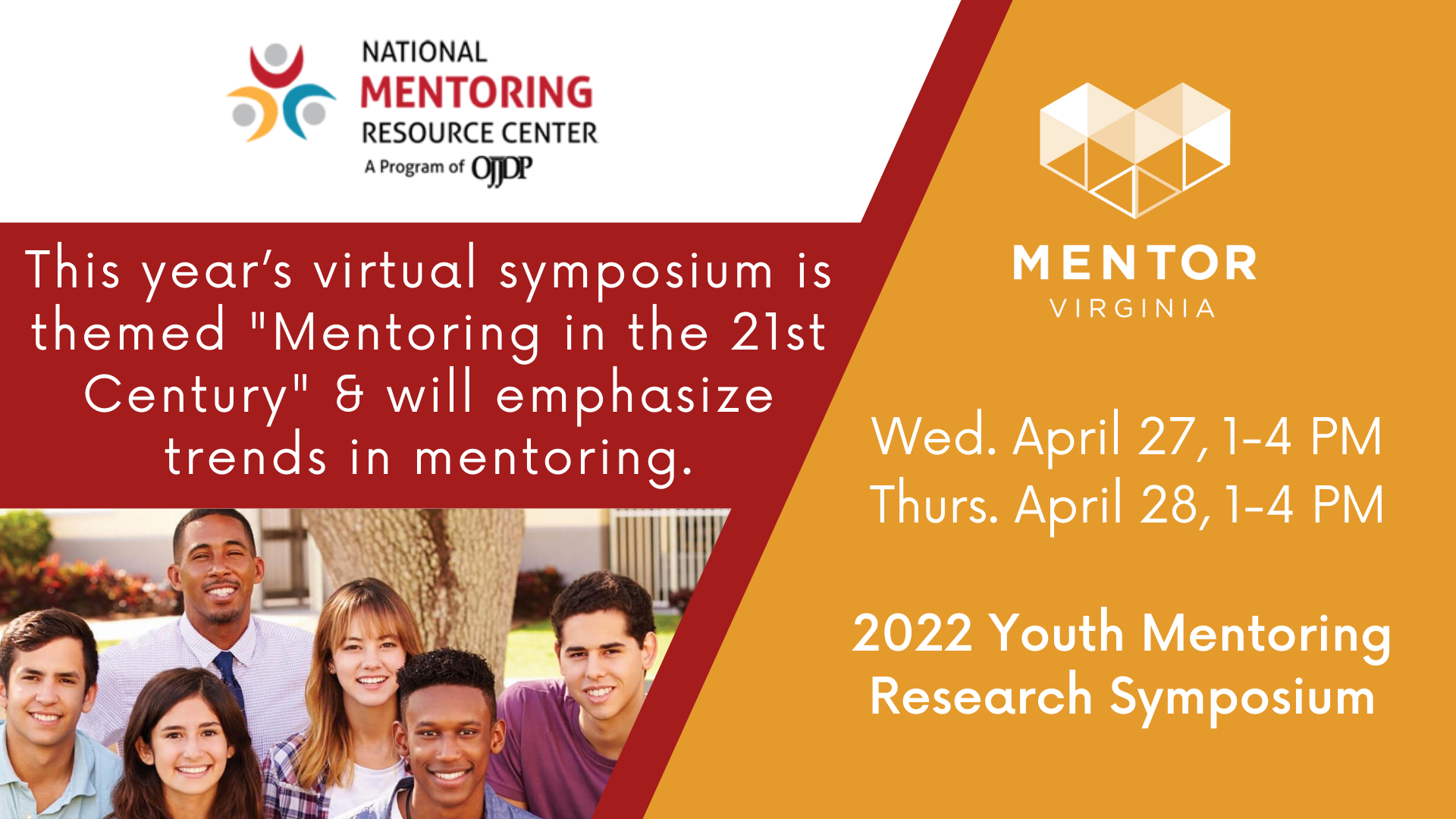
Register for the symposium here.
We are happy to announce that registration is now open for the 2022 Youth Mentoring Research Symposium, sponsored by the National Mentoring Resource Center with funding from the Office of Juvenile Justice and Delinquency Prevention. This year’s symposium will be a virtual event with a theme of Mentoring in the 21st Century, which will emphasize important new trends in mentoring research and mentoring services, especially those that can improve juvenile justice and related outcomes and promote youth thriving in our rapidly changing world.
The two-day symposium will take place Wednesday, April 27, 1-4 PM (All times in Eastern), with a special poster session from 6-7 PM, and Thursday, April 28, 1-4 PM.
As in past years, the symposium will offer both new and experienced researchers in youth development, education, health, and related fields an opportunity to come together to discuss the state of research on key mentoring topics that impact public policy and philanthropy and to learn from each other about cutting-edge frameworks and methodologies for conducting stronger research on mentoring programs and relationships. Those whose roles and/or backgrounds are not in research or evaluation are also very welcome to attend and have done so each of the prior symposia.
Day 1, 4/27 Schedule of Events:
1:00 – 1:10 – Opening Remarks by David DuBois
Description: The chair of the NMRC Research Board will welcome attendees and set the stage for our theme.
1:10 – 1:20 – Review of the Juvenile Justice Research Agenda Developed at the 2021 Symposium
Description: At the 2021 Symposium, attendees worked with presenters to identify key new research activities and priorities that would help improve the effectiveness of mentoring services with the goal of preventing juvenile crime and delinquency, as well as support young victims of crime and exploitation. Several members of the main and Associate Research Boards will present the synthesized results of the priorities attendees nominated and speak to their significance for our field.
Description: This panel discussion will focus on the need for innovative disruptions in youth mentoring, as posited by Cavell et al. (2021) in their paper, “Back to the Future: Mentoring as Means and End in Promoting Child Mental Health”. Panel members are the authors of this paper (Tim Cavell, Renee Spencer, Sam McQuillin) as well as two researchers whose work focuses more explicitly on youth of color (Bernadette Sanchez and Noelle Hurd). The presentation will review specific disruptions that may be helpful to the field of youth mentoring in the years ahead (as offered by Cavell and colleagues), focusing on innovations in the science of mentoring research itself, innovations in programming, and innovations in policy and funding of services. The presentation will be followed by breakout discussion with attendees about which innovations seem most relevant to their work.
2:25 – 3:00 Emerging Scholars Presentation: Do Mentors Benefit, Too? Emerging Findings and Promising Future Directions for Research
Description: New Research Board members Amy Anderson and Kristian Jones will lead this presentation. Youth mentoring research has historically focused on mentees’ experiences from youth mentoring. However, given that many formal mentoring relationships often occur across lines of social difference, it is likely that mentors are being exposed to realities that they have not personally experienced, and are also experiencing changes in their own lives. This plenary brings together two programs of research with a shared focus on the benefits that volunteer mentors receive as a result of mentoring.
6:00 – 7:00 Poster Presentations
Description: This optional social time offers attendees the opportunity to attend brief poster presentations from a curated selection of researcher and practitioner submissions. Attendees will move between zoom room poster areas where they can network with the poster authors and discuss their research project and implications for their work.
Day 2, 4/28 Schedule of Events:
1:00 – 1:50 Concurrent Research Workshops 1
(specific sessions TBD)
2:00 – 2:50 Concurrent Research Workshops 2
(specific sessions TBD)
The following workshops will be presented on Day 2 of the Symposium. Specific workshop times are yet to be determined.
Workshop – Use of Technology in Mentoring
Presenters: Michelle Kaufman & Sally Lindsay
Overview: Children and adolescents experience many developmental challenges, including higher risk of poor self-esteem; experimentation with substances; navigating relationships with family, peers, and romantic interests; and social isolation, particularly during pandemic times. Electronic mentoring is a potentially viable approach for reaching more youth with reduced access to mentoring, such as youth with disabilities and health concerns, youth with fewer mentors in their immediate communities, and youth with stigmatized identities. We describe a systematic review of e-mentoring programs addressing youth health and highlight an example of an online self-determination toolkit for the mentoring of youth with disabilities.
Workshop – Research on Mentoring LGBTQIA+ Youth: Exploring Identity, Assessing Climate, and Understanding the Importance of Intersectionality
Presenters: Christian Rummell & Katie Edwards
Overview: The purpose of this presentation is to take a closer look at research on mentoring for LGBTQIA+ youth, including the role of mentors in identity development, findings from a national mentoring program climate survey, and guidance for asking questions on sexual orientation and gender identity. In addition, an emphasis will be placed on impactful mentorship of multiple minoritized LGBTQIA+ youth. The presentation will draw on the extant literature as well as insights from the presenters’ work and practice-based knowledge.
Workshop – Transitional Mentoring
Presenters: Tim Cavell & Heather Taussig
Overview: We plan to discuss the concept of transitional mentoring, an approach to youth mentoring proposed by Cavell et al. (2021) in their paper, “Back to the Future: Mentoring as Means and End in Promoting Child Mental Health”.
As described by Cavell and colleagues, transitional mentoring involves providing a safe, consistent, and supportive mentoring relationship to youth going through a specific transition in their life. Examples include moving into middle school or high school, adjusting to a newly diagnosed health condition (e.g., diabetes), leaving a treatment setting or a system of care (e.g., inpatient psychiatric hospitalization, juvenile justice, foster care), coming out as a member of the LGBTQ community, or adjusting to changing family circumstances (e.g., parental divorce, incarceration, or death.)
Both Cavell and Taussig have experience developing and evaluating theory-driven mentoring programs that support a specific population of youth facing important and challenging transitions. Cavell has focused on school-based mentoring for elementary school children who are bullied by peers and will soon transition to middle school, where school bullying peaks in frequency. Taussig has developed mentoring programs for child welfare-involved youth to support them during living transitions and also during the critical transitions from elementary to middle school and middle school to high school.
Workshop – Relationship Building with Mentors and Other Adults in Institutional Positions of Power: Exploring Opportunities and Challenges
Presenters: Grace Gowdy & Aisha Griffith
Overview: This presentation will focus on relationship building with mentors, particularly those in relative positions of power. This presentation will first highlight the specific power of mentoring relationships with “capital mentors,” people connected with formal institutions such as the young person’s place of school or employment. The presentation will then zoom in on the types of interactions with school staff that uplift versus undermine Black students’ positive experiences within school. Our two presenters will focus on the ability of these relationships to create positive change for young people by presenting on a myriad of studies on the subject.
Workshop – Historical Trauma and Mentoring: Understanding the Impact on Youth
Presenters: Crystal S. Aschenbrener, Janae K. Wright, Shunicka S. Martin, Karen I. Lopez
Overview: Understanding the impact of historical trauma is critical when mentoring youth who identify with minority races, cultures, gender, sexuality, and class as well as development programing that serve them. This session will examine how mentoring programs and researchers can consider trauma in their work and design studies that highlight how services alleviate trauma symptoms and support positive youth development in the wake of trauma.
 Pamela Johnson
 Emma Rush
 Tamice Spencer-Helms
 James Harris
 Patryk Czescik
 Nishaun Battle
 Sindy Montalvo
 Kinshasa Samuel
 Tashara S. Void
 Virginia Patterson
 Tiara Whitfield
 Alexandra Clayton
 Cailey Cummins
 Andrea Wiegard
 Arya Pazhwak
 Briana Oyler
 Antonio Mielak
 Jessica Fittro
 Yvonnia Bryant
 Ayannah Bowman-Williams
 Alexa Augone
 Stephanie Hunter
 Allyson Roberts
 Bianca Myrick
 John Harris
 Laura Leporati
 Tammie Mobley
 Ashley Williams
 Abbie Wolf
 Melody Lutz
 Emily Bolinger
 Jessica Hand
 Blake Mogel
 Lynsey Meissner
 Tiffany Patton
 Rameka Blakey
 Katelyn Chau
 Hope Davis